


God is calling us into our true selves | Word Alive
Susan HooKong-Taylor
Friday, March 25, 2022
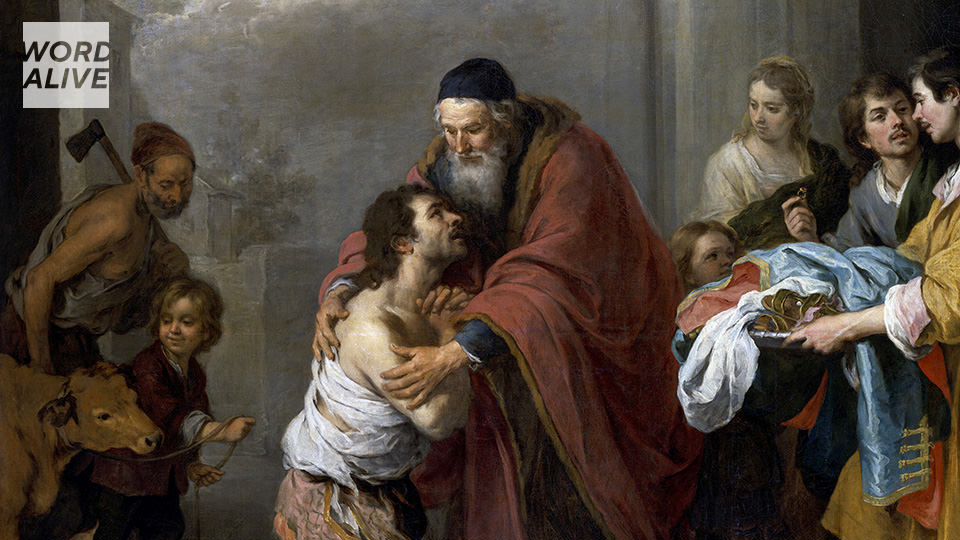
Detail of Return of the Prodigal Son by Bartolomé Esteban Murillo (Source: Wikimedia Commons)
>
 Susan HooKong-Taylor is a singer/songwriter from Toronto, Canada, as well as a recently retired Religion and Family Life Resource Teacher with the Toronto Catholic District School Board. She has had the privilege of writing and performing music for World Youth Day in Toronto, most notably, the Song of the Cross, which she co-wrote with Ana Da Costa. She is the Vice President for the charitable organization, Canadian Samaritans for Africa, which works to build on the assets of African women through micro-financing opportunities to support income generating activities. She was happily married to Kyle Taylor+ for 24 years, and together they have two children, Evan and Julia.
 Word Alive features Catholic voices of different ages, spiritualities, and walks of life. Each Friday we bring you a unique take on the Mass readings for the coming Sunday with a personal reflection that helps bring the Word of God closer to us and our everyday lives.
God is calling us into our true selves
A reflection for the Fourth Sunday of Lent, Year C
by Susan HooKong-Taylor
“Today, I have rolled away from you the disgrace of Egypt.” I think of that young man, collapsing in his father’s arms after the long journey home, full of anticipation of his father’s wrath and rejection, blurting out the speech he had rehearsed over and over as he travelled the many miles home: “Father, I have sinned against heaven and before you…I am not worthy to be called your son…”– only to be joyfully surprised by the steadfast and enduring love of his father. In this moment of gracious forgiveness and acceptance, the disgrace of his shameful behaviour, his willingness to be a slave to his passions, his disregard for his heritage and his inheritance are all rolled away by love. How incredible this is! It is a humiliating place to be in – to know you are completely in the wrong, to know you are not deserving of any mercy. It is like a giant spotlight being shone on you, and the evidence is irrefutable. It is like being pinned. The Gospel says that “he came to himself”. The desperate situation in which he finds himself – foraging for food among the swine – forces him to release all illusions of grandeur that he had of himself and face the reality of his life and what he has become. I remember being in an argument with my husband. I had done something that had hurt him terribly – something that potentially could break us, and I didn’t (wouldn’t) see it. I found ways to explain, to spin, to reframe the incident. We went back and forth arguing for some time, and I think I felt somewhat clever, capitulating, deflecting, and refusing to accept I was in the wrong. My pride had me by the throat. Finally, he said, “Stop it – just stop it.” The way in which he said this conveyed how hurt he was yet still how much he loved me and how he needed me to be in the truth of it, both his love for me and the wrong I had done. I looked at him, and seeing the love in his eyes and the pain that I had caused, I, too, came to myself. All my manoeuvres lurched to a stop. My need to be right and defend myself loosened its grip and crumpled to the floor. And then I said, I’m sorry. Full stop. What I did was wrong. It hurt you. Terribly. No excuses. No explanations. It was like what I did pulled us out of orbit. But in that moment of truth, we were able to return to the centre of who we are together. In the reading from the book of Joshua, we hear that the manna ceases the day that they are able to eat the produce of the land where God has led them. They are able to set down roots, build, cultivate, and reap from their efforts. The old truly had passed away. A new life had begun in this promised land. In the same way, God is calling us into our true selves and into His promise for us – to be the new creations in Christ we are called to be. God says to us today that the time of wandering around the periphery of ourselves, where we accumulate false perceptions of ourselves, inflated egos, and broken and bitter hearts, is over. God says to us, you are infinitely more than the hurts you have suffered or the mistakes you have made. Again and again, God tells us, we are made in love, for love, and for glory. It is time to “come to ourselves”, truly and completely, just as God intended. Finally, God “rolls away the disgrace of Egypt” in this way: God invites us to gather at His table and partake of his eternal banquet by bringing all that we are and all that we offer. And so we pray: Blessed are you, Lord God of all creation, for through your goodness we have received the bread we offer you; fruit of the earth and work of human hands, it will become for us the bread of life.” Blessed be God forever.The readings for the Fourth Sunday of Lent, Year C, are Joshua 5:9a, 10-12 2 Corinthians 5:17-21 Luke 15:1-3, 11-32
Susan HooKong-Taylor is a singer/songwriter from Toronto, Canada, as well as a recently retired Religion and Family Life Resource Teacher with the Toronto Catholic District School Board. She has had the privilege of writing and performing music for World Youth Day in Toronto, most notably, the Song of the Cross, which she co-wrote with Ana Da Costa. She is the Vice President for the charitable organization, Canadian Samaritans for Africa, which works to build on the assets of African women through micro-financing opportunities to support income generating activities. She was happily married to Kyle Taylor+ for 24 years, and together they have two children, Evan and Julia.
Click here for all articles in the Word Alive series



Related Articles:
<<
SUPPORT LABEL
$50
$100
$150
$250
OTHER AMOUNT
DONATE
Receive our newsletters
Stay Connected


Receive our newsletters

Stay Connected