Front row seats for Vatican II


Catholic News Service recently interviewed 97 year old Archbishop Loris Capovilla. Archbishop Capovilla was prelate of the sanctuary of the Holy House of Loreto, Italy for many years. Before that however, he was the personal secretary to Pope John XXIII. He had a privileged vantage point for Vatican II, he saw the circumstances that lead John XXIII to call the council and was at the pope’s side through the council. He was also at the pope’s side when he opened the third secret of Fatima. In this video Archbishop Capovilla reflects on the Second Vatican Council.

Perspectives Daily – Monday, May 14


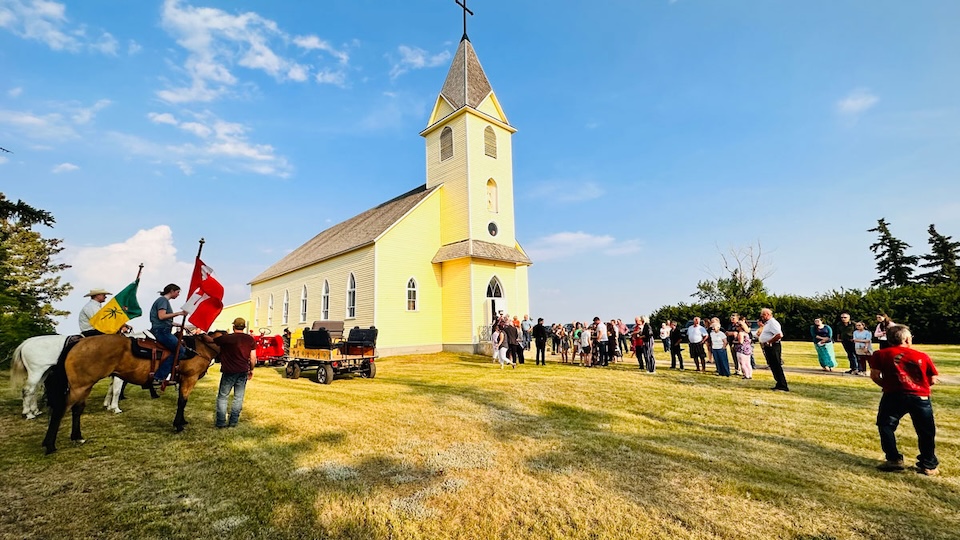
Tonight on Perspectives: Pope Benedict XVI visits a 1000 year old town, the Canadian Bishops release guidelines on freedom on conscience and religion, and Saskatoon blesses its new Cathedral.

Our Lady of Lujan


Lujan, Argentina, 1630
– A devoutly Catholic farmer from Portugal arrives in the northern Argentine town of Sumampa, in the province of Santiago del Estero. To his great dismay his faith is not well known or shared in his new hometown.  In order to feel more at home he takes it upon himself to build a small shrine to Our Lady on his property. He writes to a friend in Brazil and asks him to send a small statue of Mary.

The friend in Brazil is torn between two options. Not knowing which his friend might like better, he sends both. One is the virgin and child, the other is the immaculate conception. The statues travel by sea and then by horse-drawn cart.

At the time there was fighting with the natives, so for safety reasons several horse-drawn carts banded together to travel as a caravan. One night they camp out on the property of Don Rosendo de Oramus. The next morning the carts prepare to continue their journey. One by one the carts start moving…except for one cart. The cart carrying the statues of Our Lady simply refuses to budge. Try as they might the men simply cannot get the horses to start moving.
[Read more...]

CCCB Pastoral Letter & Message from Archbishop Smith


Earlier today, the Permanent Council for the Canadian Conference of Catholic Bishops released a pastoral letter on freedom of conscience and religion. Issued by the CCCB’s Permanent Council, the letter expresses concern about an “aggressive relativism” in Canada that seeks to relegate religion to the private sphere.

More than that, the Permanent Council explains why freedom of religion and conscience is necessary for the common good of countries such as Canada where religious diversity is the norm.

Published below is a message from Archbishop Richard Smith, president of the Canadian Conference of Catholic Bishops.

Dear brothers and sisters,

Throughout the 50 days of Eastertide, we are reminded that the Church is to witness to God and to faith in Jesus Christ. The Scripture readings in the liturgy from Easter Sunday to Pentecost recall how the first disciples were transformed by the Holy Spirit, filled with conviction, courage and new life, and together became the community of life, hope, forgiveness and truth.

Yet today, our own Catholic community and other faiths throughout the world are experiencing a worrisome erosion of freedom of conscience and freedom of religion. There are even numerous distressing attacks on both these intimately related freedoms. Sometimes this happens by overt violence. Sometimes it involves more subtle means, as in the case of legislative actions that limit the respect owed to the conscience of each person, or inhibit the right of all religions, or of their individual believers, to live their faith publicly and to follow the dictates of a well-formed conscience.
[Read more...]

Fr. Rosica’s address to the Ontario Provincial Meeting of Development and Peace


May 12, 2012, Toronto - 
I am very grateful to Luke Stocking and the Canadian Catholic Organization for Development and Peace for the invitation and privilege of addressing you this morning during this important provincial gathering.  More than anything, it is an opportunity for me to express once again my gratitude to each of you for your commitment, witness and perseverance.  I cannot stand before you without evoking the tremendous collaboration we enjoyed together ten years ago as we prepared for World Youth Day 2002 in Toronto and celebrated our Catholic Christian identity and mission on a grand scale.  Through the great generosity of Development and Peace, we were able to have made in the barrios of Colombia, South America over 500,000 small wooden crosses that Pope John Paul II presented to each young pilgrim who took part in World Youth Day in Canada.  Through your generous contribution, we had made by women’s cooperatives in Chiapas, Mexico, the beautiful stoles for 500 priest confessors who celebrated the Sacrament of Reconciliation with the tens of thousands of young people of the world in Duc in Altum Park and at Downsview Park. Working closely with your regional leaders, we involved over 100,000 young people in the service projects that took place on the Wednesday afternoon of World Youth Day week.  And seizing the tremendous good will of your volunteers, we prepared the famous red pilgrim bags that had been stitched together in the prisons of Quebec.  It was the World Youth Day of 2002 that allowed Development and Peace to launch a new outreach to young men and women in this country.  Many of you at that time called the World Youth Day a “refounding” moment for the Canadian Catholic Organization for Development and Peace.

Now ten years later, I come before you to encourage you once again in the important ecclesial mission entrusted to Development and Peace, and to reflect on what it means to be a convinced and convincing witness to Jesus Christ and the long, rich tradition of the social teaching of the Church.   You have asked me to speak about “Catholic Communications, Identity and Mission,” a theme that has been at the heart of my ministry especially over the past 10 years since the establishment of the Salt and Light Catholic Media Foundation and Television Network.  I will situate my remarks in the context of the “Year of Faith” that has been announced by Pope Benedict XVI – a year that will begin on October 11, 2012, the date that marks the fiftieth anniversary of the opening of the Second Vatican Council.  The Year of Faith will conclude on the Solemnity of Christ the King, on November 2013.
[Read more...]

Our Lady of Guadalupe


Tepeyac, Mexico, 9 December 1531. A young woman appears to an indigenous peasant named Juan Diego. The woman, initially identified by Juan Diego as a teenaged Aztec princess, asks Juan Diego in his native language to have a shrine built in her name– she introduces herself as the Blessed Virgin Mary– on the site where he is standing. Juan Diego is sent to ask the permission of the bishop to build the shrine. The bishop, the Spaniard Juan de Zumárraga, is sceptical that Juan Diego had actually seen the Mother of God, so Juan Diego returns to Tepeyac. There, Our Lady appears to him again, this time promising him a sign that will convince Bishop de Zumárraga to do as she has requested.

The next day, on his way to visit his dying uncle, Juan Diego encounters the Virgin a third time. She assures him that his uncle will live, and tells him to go to Tepeyac in mid-winter and to gather Castilian roses– flowers native to the bishop’s homeland– and to bring them to Bishop de Zumárraga. Standing in front of the bishop to request again the construction of a shrine on Tepeyac, Juan Diego lets the Castilian roses fall from his cloak, on which an image of Mary has become imprinted. Later, he finds his uncle in good health. Bishop de Zumárraga is convinced by this “Sign of the Roses” that a shrine to Our Lady must be built. The Virgin who had appeared to Juan Diego had identified herself as Our Lady of Guadalupe. Devotion to Our Lady under this name begins to spread rapidly in the Americas and remains to the present the most popular Marian title in Latin America.

Millions of Aztecs were converted to Christianity within a few years of those events on December 12, 1531.  Today, nearly five-hundred years later, that image can still be seen on Juan’s tilma in the Basilica of Our Lady of Guadalupe.  No scientific explanations have been found for the original image, the physical integrity of the tilma itself (which should have naturally decomposed many centuries ago), or the flowers which Juan brought to the bishop.

On July 31, 2002, Pope John Paul II visited the Basilica of Our Lady of Guadalupe and proclaimed Juan Diego a saint – the first indigenous saint of the Americas.  Quoting the Mexican bishops, JPII stated that, “The Guadalupe Event meant the beginning of evangelization with a vitality that surpassed all expectations.  Christ’s message, through his Mother, took up the central elements of the indigenous culture, purified them and gave them the definitive sense of salvation.” (Homily of John Paul II, Mexico City, July 31, 2002)  The power and depth of that event, encountered in the image of Our Lady, continues to inspire millions of devotions and pilgrimages each year.

photo courtesy of Catholic News Service

With files from Warren Schmidt, CSB, courtesy of Madrid11.com